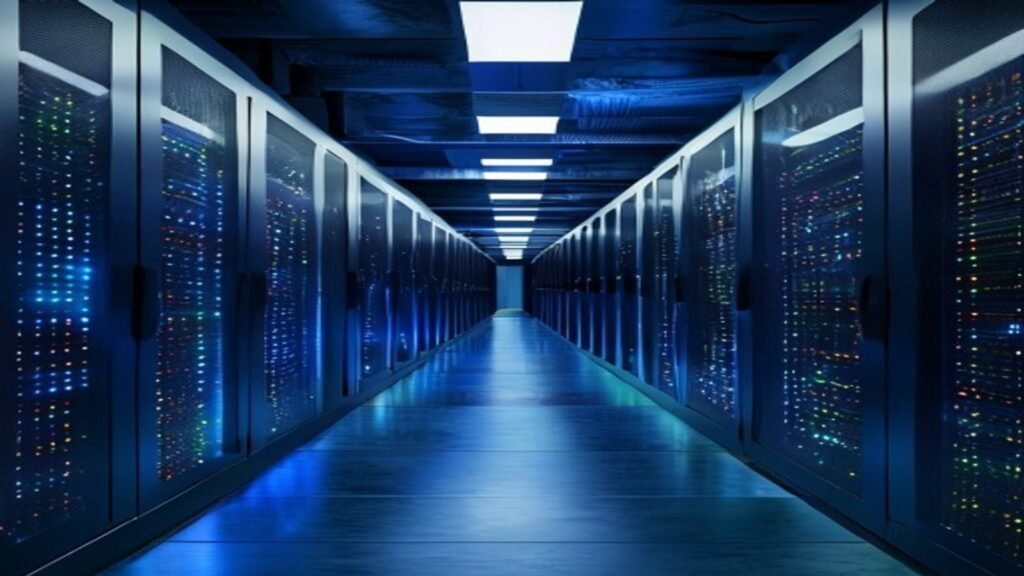
For twenty years American electricity demand was essentially flat. Efficiency gains in lighting, motors and appliances offset economic growth, and utilities planned around replacing old capacity rather than adding new. That era ended. Data centre construction driven by artificial intelligence workloads has turned load growth back into the central planning problem for large parts of the U.S. grid, and the consequences reach from chip design to state utility commissions.
Why AI computing is different
A conventional server rack draws perhaps five to ten kilowatts. A rack densely packed with accelerators designed for training large models can draw ten times that, and the newest designs push higher still. Power density of that order changes the physical building: air cooling becomes inadequate, liquid cooling moves from exotic to standard, and the electrical infrastructure — transformers, switchgear, backup generation — becomes a larger share of project cost than the shell.
Read moreHow a Patent Becomes an Actual Product
It also changes the siting calculation. A campus requiring several hundred megawatts cannot be placed wherever land is cheap; it must be placed where a transmission interconnection can be obtained in a reasonable time. Interconnection queues in most U.S. markets are measured in years, and reform of that process is one of the more consequential unglamorous fights in American energy policy. National projections of electricity demand and generation additions are published by the U.S. Energy Information Administration.
The utility problem
Regulated utilities earn a return on capital invested in infrastructure, which in principle makes large new loads attractive. The complication is who bears the risk. If a utility builds transmission and generation for a data centre campus that is later cancelled or relocated, the cost falls on remaining ratepayers. Several state commissions have responded by creating special tariff classes for very large loads, with minimum take obligations and long contract terms designed to shift stranded-asset risk onto the customer requesting the connection.
Reliability planners face a related question. Data centres are extremely steady loads, which is helpful, but they are also intolerant of interruption and increasingly located in clusters that concentrate risk geographically. Assessments of resource adequacy across North American regions are published by the North American Electric Reliability Corporation, and recent editions have flagged the pace of load growth as a distinct risk factor.
Read moreWhat a 10-K Really Tells You About a Company
Where the power comes from
The companies building these facilities have public commitments to carbon-free energy, and the mismatch between those commitments and the speed at which firm clean capacity can be built has produced some creative procurement: long-term contracts for existing nuclear output, investment in advanced reactor development, geothermal offtake agreements and large-scale storage paired with solar. In the near term, however, gas generation remains the practical answer for firm capacity in most U.S. markets, which is why emissions from the sector are rising even as the average grid gets cleaner. Analysis of energy demand from computing is tracked internationally by the International Energy Agency.
The efficiency counterargument
Every previous computing wave triggered similar warnings, and each time efficiency improvements absorbed much of the projected growth. Chip performance per watt continues to improve rapidly, model architectures are becoming cheaper to serve per query, and inference is migrating toward smaller specialised models. Historical work on data centre energy use, including studies published through the U.S. Department of Energy national laboratories, found that computing output rose by orders of magnitude between 2010 and 2020 while energy use rose only modestly.
Whether that pattern repeats depends on whether efficiency gains outrun demand growth, and the honest answer is that nobody knows. What is certain is that electricity has become a strategic input for the technology industry, that the constraint on AI deployment in the medium term is as likely to be a transformer order book as a shortage of engineers, and that utility regulation — long the dullest corner of American infrastructure policy — now sits on the critical path of the industry’s expansion.
Read moreIndex Funds Now Own Wall Street. What Changes
The constraint is interconnection, not generation
The shortage limiting new data centre construction is not a shortage of electricity in the abstract. It is a shortage of the specific ability to connect large new loads to the grid at particular points, on a timeline shorter than the years required to permit and build transmission. Queues for interconnection now run longer than the construction schedule for the facilities themselves, which is why operators have begun pursuing behind-the-meter generation, co-location with existing plants, and long-term contracts for firm capacity that would have looked eccentric a few years ago.
Reliability assessments published by NERC identify large flexible loads as a planning question rather than simply a demand increase, because a facility that can curtail during peak hours is a very different asset to a grid operator than one that cannot. That flexibility is the most likely resolution: computing workloads that tolerate interruption or geographic shifting are unusually well suited to being paid for curtailment. Whether the industry accepts that trade in exchange for faster connection is the practical question the next several years will settle.